
Explore the types of BIM services including 3D, 4D, 5D, and 6D BIM. Learn how each BIM dimension improves design, planning, cost estimation, and facility management for architects.
Table of Contents
Introduction to Types of BIM Services
The construction and architecture industry is rapidly evolving. Today, firms are shifting from traditional drafting methods to intelligent digital workflows. This is where types of BIM services play a crucial role.
Building Information Modeling (BIM) is not just about 3D modeling. Instead, it is a complete process that integrates design, time, cost, and lifecycle management into one system.
In this blog, we will explore the types of BIM services in detail. Specifically, we will cover:
- 3D BIM (Design Visualization)
- 4D BIM (Time Scheduling)
- 5D BIM (Cost Estimation)
- 6D BIM (Facility Management)
Additionally, we will connect these concepts with:
- BIM vs CAD: Key Differences Architects Must Know
- Complete Guide to BIM Services for Architecture Firms
Why Understanding Types of BIM Services is Important
Before diving deeper, it’s important to understand why learning the types of BIM services matters.
Firstly, BIM improves collaboration between architects, engineers, and contractors. Secondly, it reduces errors and rework. Moreover, it enhances project efficiency and profitability.
Unlike traditional CAD workflows, BIM adds intelligence to design. If you haven’t already, you should explore BIM vs CAD: Key Differences Architects Must Know to understand this transformation clearly.
Overview of Types of BIM Services
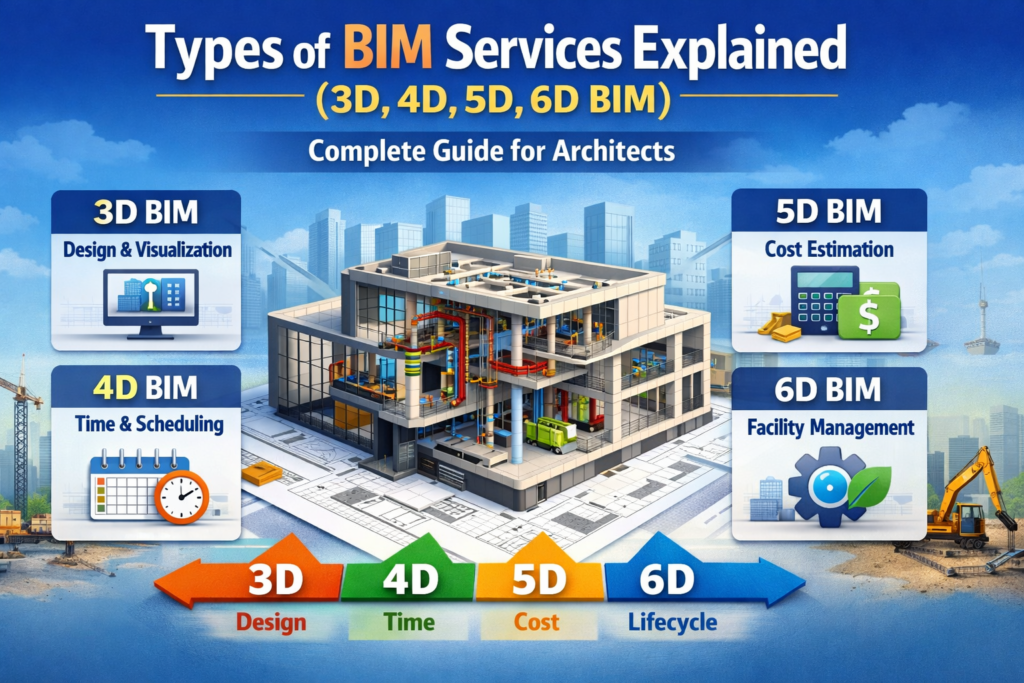
The types of BIM services are categorized based on dimensions. Each dimension adds a new layer of information to the project.
| BIM Type | Description |
|---|---|
| 3D BIM | Design and visualization |
| 4D BIM | Time scheduling |
| 5D BIM | Cost estimation |
| 6D BIM | Facility management |
Now, let’s explore each type in detail.
3D BIM: The Foundation of All Types of BIM Services
3D BIM is the most basic yet essential among all types of BIM services.
What is 3D BIM?
3D BIM involves creating a digital 3D model of a building. This model includes architectural, structural, and MEP components.
Unlike 2D drawings, 3D BIM provides a realistic visualization of the project.
Learn more about BIM on Autodesk
Key Features of 3D BIM
- Accurate 3D visualization
- Clash detection
- Improved design coordination
- Better client presentations
Benefits of 3D BIM
Firstly, it helps architects visualize the project clearly. Secondly, it reduces design errors. Moreover, it improves communication with clients.
For example, instead of showing flat drawings, you can present a complete 3D walkthrough.
Use Cases of 3D BIM
- Residential projects
- Commercial buildings
- Interior design planning
- Renovation projects
How 3D BIM Connects to Other BIM Services
3D BIM acts as the base for all other types of BIM services. Without it, 4D, 5D, and 6D BIM cannot exist.
4D BIM: Adding Time to BIM Services
Once the 3D model is ready, the next step in the types of BIM services is 4D BIM.
What is 4D BIM?
4D BIM adds the element of time to the 3D model. It links construction activities with scheduling data.
Key Features of 4D BIM
- Construction sequencing
- Timeline visualization
- Project scheduling
- Progress tracking
Benefits of 4D BIM
Firstly, it improves project planning. Secondly, it reduces delays. In addition, it enhances coordination between teams.
Because of this, contractors can plan activities more efficiently.
Use Cases of 4D BIM
- Construction planning
- Infrastructure projects
- Large-scale developments
Why 4D BIM is Important
Without proper scheduling, even the best designs can fail. Therefore, 4D BIM ensures timely project execution.
5D BIM: Cost Estimation in BIM Services
Cost control is critical in any project. That’s why 5D BIM is one of the most valuable types of BIM services.
What is 5D BIM?
5D BIM integrates cost data with the 3D model. It allows real-time cost estimation.
Key Features of 5D BIM
- Quantity take-offs
- Cost estimation
- Budget tracking
- Financial forecasting
Benefits of 5D BIM
Firstly, it improves cost accuracy. Secondly, it reduces budget overruns. Moreover, it helps in better financial planning.
Use Cases of 5D BIM
- Tendering process
- Cost analysis
- Project budgeting
How 5D BIM Helps Architects
Architects can make cost-effective design decisions. As a result, projects become more feasible and profitable.
6D BIM: Facility Management and Sustainability
Among all types of BIM services, 6D BIM focuses on long-term building performance.
What is 6D BIM?
6D BIM includes data related to building maintenance and lifecycle management.
Key Features of 6D BIM
- Asset management
- Energy analysis
- Maintenance scheduling
- Lifecycle tracking
Benefits of 6D BIM
Firstly, it improves building efficiency. Secondly, it reduces maintenance costs. In addition, it supports sustainability.
Use Cases of 6D BIM
- Facility management
- Smart buildings
- Green building projects
Why 6D BIM is the Future
As sustainability becomes important, 6D BIM will play a major role in modern architecture.
How Types of BIM Services Work Together
The real power of types of BIM services lies in integration.
- 3D BIM → Design
- 4D BIM → Time
- 5D BIM → Cost
- 6D BIM → Lifecycle
Together, they create a complete digital ecosystem.
BIM vs CAD: Why BIM Services are Better
Traditional CAD lacks intelligence. It only provides drawings.
However, BIM offers data-rich models.
If you compare both, as explained in BIM vs CAD: Key Differences Architects Must Know, BIM clearly stands out.
Key Differences
- CAD is 2D-focused
- BIM is data-driven
- CAD lacks collaboration
- BIM improves teamwork
Therefore, modern firms are adopting BIM rapidly.
How BIM Services Help Architecture Firms
According to Complete Guide to BIM Services for Architecture Firms, BIM improves efficiency and profitability.
Major Advantages
- Faster project delivery
- Reduced errors
- Better collaboration
- Increased client satisfaction
As a result, BIM has become essential for architecture firms.
Challenges in Implementing BIM Services
Although the types of BIM services offer many benefits, there are some challenges.
Common Challenges
- High initial cost
- Training requirements
- Software complexity
However, these challenges can be overcome with proper planning.
Future of Types of BIM Services
The future of types of BIM services is promising.
Emerging trends include:
- AI integration
- Cloud-based BIM
- Digital twins
- Smart city planning
Therefore, BIM will continue to evolve and expand.
Conclusion: Why You Should Use Types of BIM Services
In conclusion, understanding the types of BIM services is essential for modern architects.
3D, 4D, 5D, and 6D BIM together create a powerful system that improves design, planning, cost, and maintenance.
If you want to grow your architecture business, adopting BIM is no longer optional. It is necessary.
Recommended BIM Tools and Resources for Architects
To better understand the types of BIM services, using the right tools and learning resources is essential.
Top BIM Software Tools
- Autodesk Revit – Industry standard BIM software
- Navisworks – Clash detection and coordination
- ArchiCAD – Advanced architectural BIM tool
👉 Learn more about BIM workflows on Autodesk
Best Books to Learn BIM (Affiliate Opportunity)
You can recommend these books with Amazon affiliate links:
- “BIM Handbook” by Chuck Eastman https://amzn.to/4cJLurD
- “Mastering Autodesk Revit” https://amzn.to/4myHKN8
- “Building Information Modeling: Planning and Managing Construction Projects” https://amzn.to/48QL0h5
Why These Tools Matter
Firstly, they help you implement all types of BIM services effectively.
Secondly, they improve productivity and reduce errors.
Moreover, they enhance project collaboration.
What are the main types of BIM services?
The main types of BIM services include 3D BIM, 4D BIM, 5D BIM, and 6D BIM.
Each type adds a different dimension such as design, time, cost, and lifecycle management.
Which BIM software is best for beginners?
Popular BIM tools include Autodesk Revit and ArchiCAD.
👉 You can explore Autodesk Revit here at www.autodesk.com
How does 5D BIM help in cost estimation?
5D BIM integrates real-time cost data with models.
As a result, architects can make accurate financial decisions.
👉 Learn cost standards from RICS
Is BIM better than CAD?
Yes, BIM is more advanced than CAD because it includes data, collaboration, and lifecycle management.
👉 Read: BIM vs CAD: Key Differences Architects Must Know
Can I learn BIM from books?
Yes, books are a great way to start.
👉 Recommended: BIM Handbook (https://amzn.to/4syqEjK)
What is the future of BIM services?
The future includes AI, digital twins, and smart cities.
👉 Learn about BIM innovation from Autodesk