
Table of Contents
Introduction
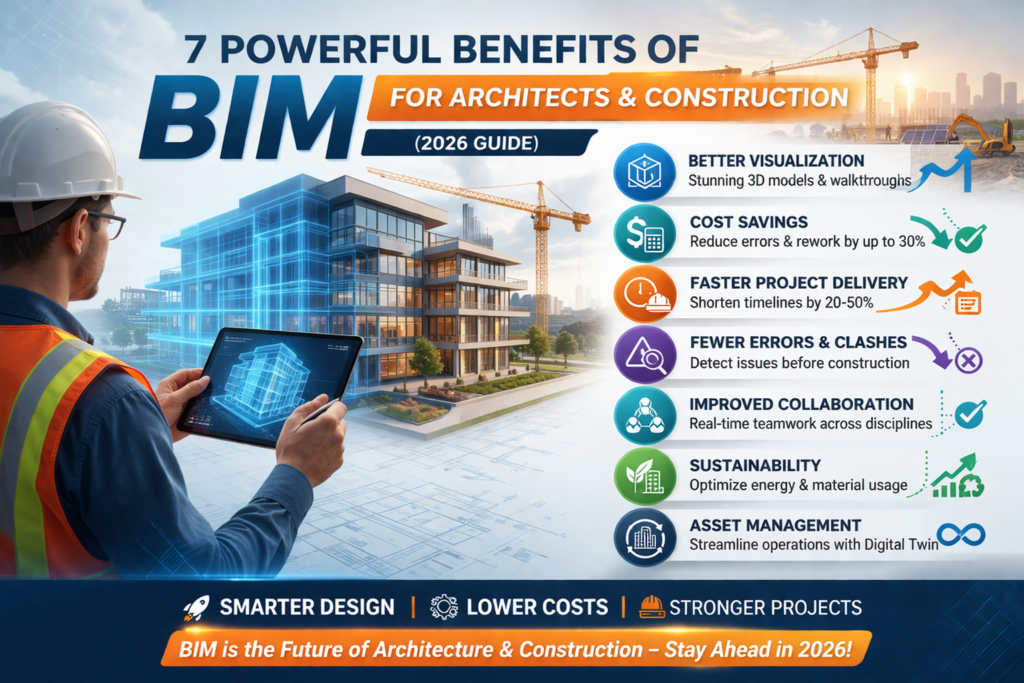
If you’re an architecture student or construction professional, you’ve probably heard a lot about Building Information Modeling (BIM). However, the real question is—why is BIM becoming essential in modern construction, and what exactly are the Benefits of BIM for Architects & Construction?
Well, the answer lies in its powerful advantages.
In today’s fast-paced construction industry, traditional methods are no longer enough. Projects are becoming more complex, deadlines tighter, and budgets stricter. Therefore, professionals are rapidly shifting towards BIM to stay competitive.
In this blog, we’ll explore the top 7 benefits of BIM for architects & construction, along with practical insights, real-world relevance, and useful resources.
Building Information Modeling (BIM) is transforming the architecture and construction industry by improving efficiency, collaboration, and accuracy. Today, many professionals rely on bim-services-for-architecture-firms to fully unlock these benefits and streamline project delivery.
👉 Before diving deeper, you can also read:
- What is BIM in Architecture? Complete Beginner Guide
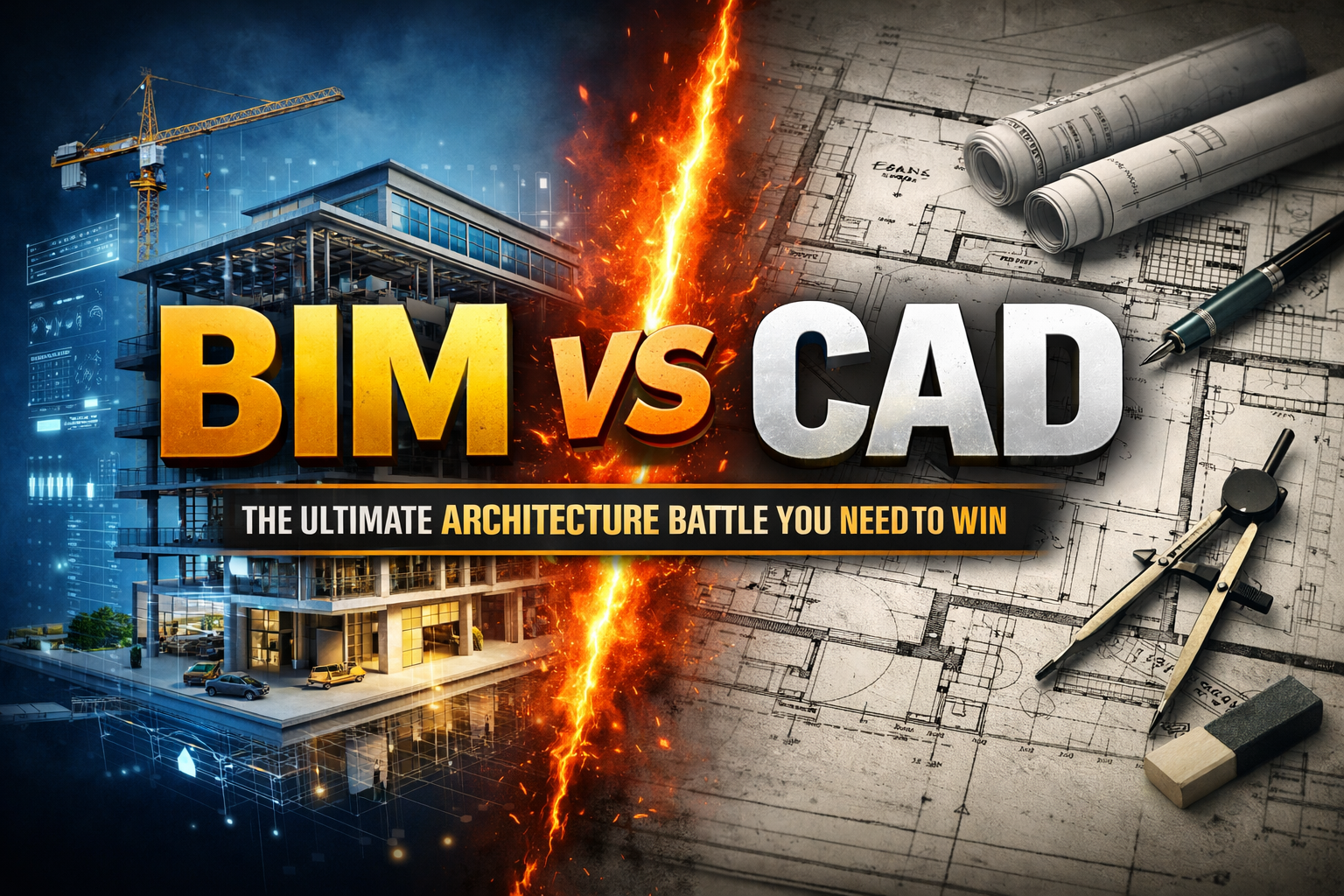
- BIM vs CAD: Key Differences Architects Must Know
- The Future of Architecture: Why BIM is Now Essential
These will help you build a stronger foundation.
What is BIM (Quick Overview)
Building Information Modeling (BIM) is a digital process that allows professionals to create and manage building data throughout its lifecycle. It integrates design, construction, and operation into a single smart model. (Autodesk)
Unlike traditional 2D drawings, BIM provides a data-rich 3D model, enabling better decision-making and collaboration.
1. Improved Collaboration & Team Coordination
First and foremost, one of the biggest benefits of BIM is enhanced collaboration.
Traditionally, architects, engineers, and contractors worked separately. As a result, miscommunication often caused errors. However, BIM changes this completely.
With BIM:
- All stakeholders work on a shared model
- Changes update in real-time
- Everyone stays aligned
Consequently, projects become smoother and more efficient.
BIM transforms the way architects, engineers, and construction teams collaborate by providing a centralized, cloud-based model that everyone can access in real time. Unlike traditional workflows where information is scattered across multiple drawings and files, BIM integrates all disciplines into a single coordinated system.
This ensures that structural, architectural, and MEP teams work in sync, reducing communication gaps and misunderstandings. Real-time updates mean that any design change is instantly reflected across the project, minimizing delays and conflicts. In a fast-paced construction environment, this level of collaboration is crucial for delivering projects efficiently and maintaining strong coordination between all stakeholders.
👉 According to industry insights, BIM creates a shared data environment that improves coordination and reduces errors. (ACCA Software)
2. Better Visualization & Design Accuracy
Secondly, BIM offers high-quality 3D visualization, which is a game-changer.
Instead of imagining designs from 2D drawings, architects can:
- View realistic 3D models
- Simulate lighting, materials, and space
- Present designs clearly to clients
As a result, decision-making becomes easier and faster.
Moreover, BIM even supports VR/AR integration, making designs more interactive and immersive.
3. Clash Detection & Error Reduction
One of the most practical benefits of BIM is early clash detection.
In traditional workflows, design conflicts (like pipes crossing beams) are discovered during construction. Unfortunately, this leads to costly rework.
However, BIM detects these issues before construction begins.
- Identifies design conflicts early
- Reduces rework
- Saves time and cost
Therefore, BIM significantly minimizes project risks.
4. Cost Estimation & Budget Control
Another major advantage is accurate cost estimation.
With BIM (5D BIM):
- Material quantities are automatically calculated
- Budget estimates are more precise
- Cost overruns are reduced
As a result, project managers can plan finances better.
👉 Studies show BIM improves cost efficiency and reduces waste through better resource planning. (ACCA Software)
5. Faster Project Completion
Time is money in construction—and BIM helps save both.
Because BIM automates many processes:
- Design updates happen instantly
- Documentation is generated automatically
- Coordination delays are reduced
Therefore, projects are completed faster.
In fact, BIM enables better planning and scheduling, improving overall project timelines. (Procore)
6. Sustainability & Energy Efficiency
Nowadays, sustainability is a top priority.
Fortunately, BIM supports green building design by:
- Analyzing energy performance
- Optimizing materials
- Reducing waste
As a result, architects can design eco-friendly buildings.
Research even suggests BIM can significantly reduce environmental impact across a building’s lifecycle. (arXiv)
7. Lifecycle Management & Facility Maintenance
Finally, BIM is not just for design and construction—it also helps in building management.
Unlike CAD, BIM continues to provide value after project completion.
With BIM:
- Facility managers can access building data
- Maintenance becomes easier
- Future renovations are simplified
Therefore, BIM supports the entire building lifecycle.
Recommended BIM Books & Tools (Affiliate Section)
If you want to master BIM, here are some useful tools and books:
📚 Books for Learning BIM
These books will help you:
- Understand BIM concepts https://amzn.to/3NMyzeT
- Learn practical workflows https://amzn.to/4db4UGM
- Improve your software skills
How BIM is Shaping the Future of ArchitectureWithout a doubt, BIM is transforming the AEC industry.
- It improves productivity
- Enhances collaboration
- Reduces errors
- Supports smart cities
Therefore, learning BIM is no longer optional—it’s essential.
👉 For deeper insights, read: The Future of Architecture: Why BIM is Now Essential
Conclusion
To sum up, the benefits of BIM for architects & construction are undeniable.
From better collaboration to cost savings and sustainability, BIM is revolutionizing how buildings are designed and constructed.
If you’re serious about your architecture or construction career, now is the perfect time to adopt BIM.
In conclusion, BIM is no longer optional but essential for modern construction projects. Leveraging expert bim-services-for-architecture-firms can help businesses stay competitive, reduce risks, and deliver high-quality results faster.
FAQs (Frequently Asked Questions)
1. What are the main benefits of BIM?
The main benefits include better collaboration, cost savings, improved visualization, clash detection, and faster project completion.
2. Is BIM better than CAD?
Yes, BIM is more advanced than CAD because it includes data, 3D modeling, and lifecycle management.
👉 Read: BIM vs CAD: Key Differences Architects Must Know
3. Can students learn BIM easily?
Absolutely. With tools like Revit and proper guidance, students can learn BIM step by step.
4. Why is BIM important in construction?
BIM improves efficiency, reduces errors, and enhances project outcomes, making it essential in modern construction.
5. What software is used for BIM?
Popular BIM software includes Revit, Navisworks, and ArchiCAD.
Final Thoughts
From my experience, once you start using BIM, it completely changes how you think about design and construction.
At first, it might feel complex. However, with consistent practice, it becomes one of the most powerful skills in your career.
So, don’t wait—start learning BIM today 🚀
Looking to implement BIM in your projects? Explore our specialized bim-services-for-architecture-firms to take your architectural workflow to the next level.
Pingback: The Future of Architecture: Why BIM Is Now Essential-2026
Pingback: BIM vs CAD: Key Differences Architects Must Know-2026 Guide
Pingback: Complete Guide to BIM Services for Architecture Firms (2026)